Topic Cluster Strategy for SEO
A strong topic cluster strategy for SEO helps websites build topical authority, improve internal linking, and rank for entire subject areas instead of isolated keywords. Google increasingly rewards websites that demonstrate deep expertise and comprehensive coverage of a topic.
Instead of publishing disconnected blog posts, modern SEO uses:
- Pillar pages
- Supporting cluster content
- Semantic SEO strategy
- Internal linking clusters
- Content architecture planning
This approach improves crawlability, strengthens E-E-A-T signals, and increases SERP visibility across multiple related keywords. To understand how topic clusters fit into the broader SEO landscape, read this guide on the power of SEO in 2026.
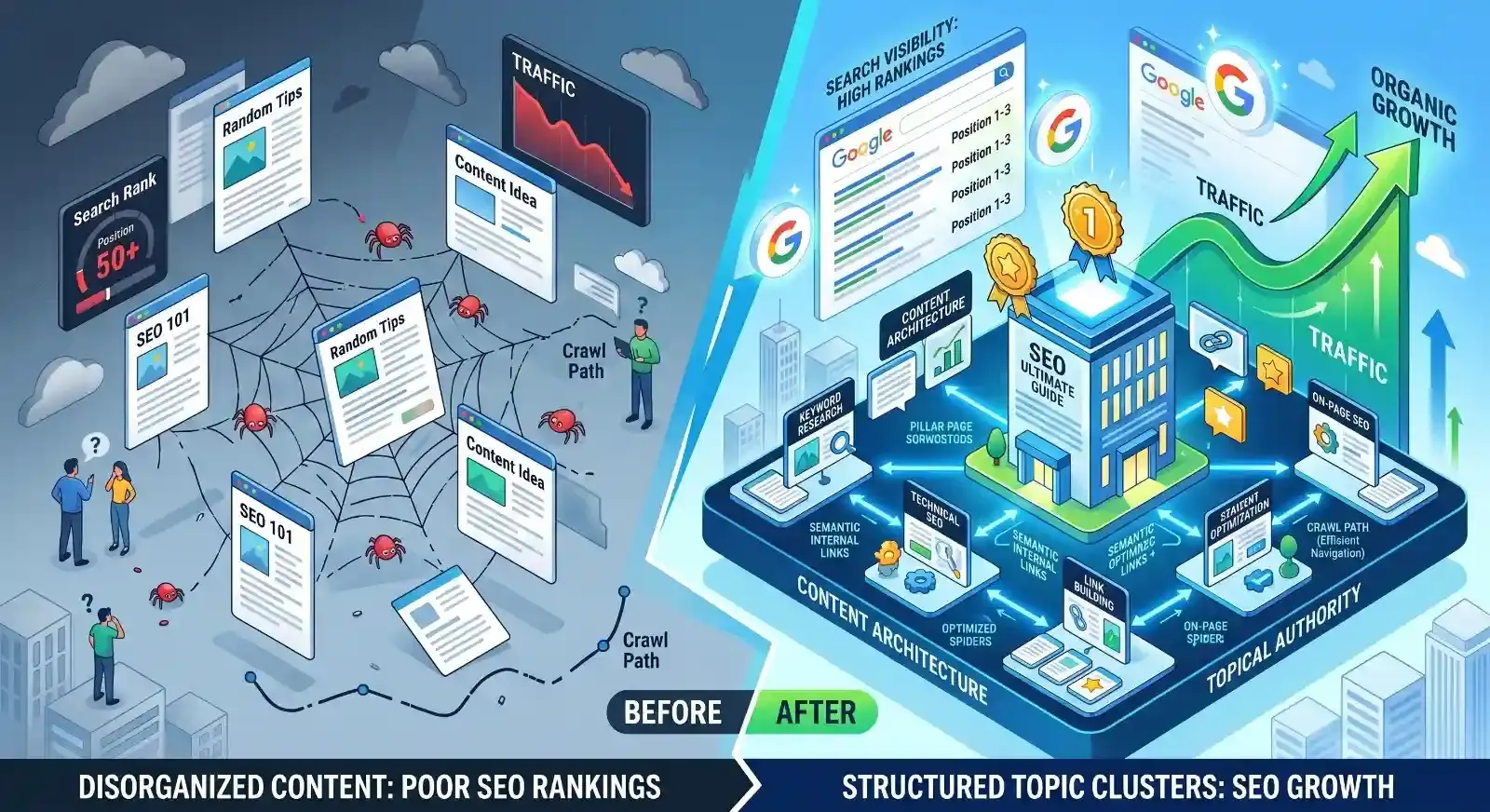
Why Topic Clusters Beat Traditional Keyword-Based Content Strategies
Traditional SEO focused on targeting one keyword per page.
Today, Google evaluates:
- Topical depth
- Semantic relevance
- Content relationships
- User satisfaction
Google Helpful Content Topical Authority
Google’s Helpful Content systems favor websites that show expertise across an entire subject area rather than isolated articles.
Benefits of Topic Clusters
- Stronger topical authority SEO
- Better internal linking
- Improved crawl efficiency
- Higher rankings across related terms
- Better user experience
This is why topic clusters outperform random blog publishing strategies.
How the Pillar-Cluster Model Works
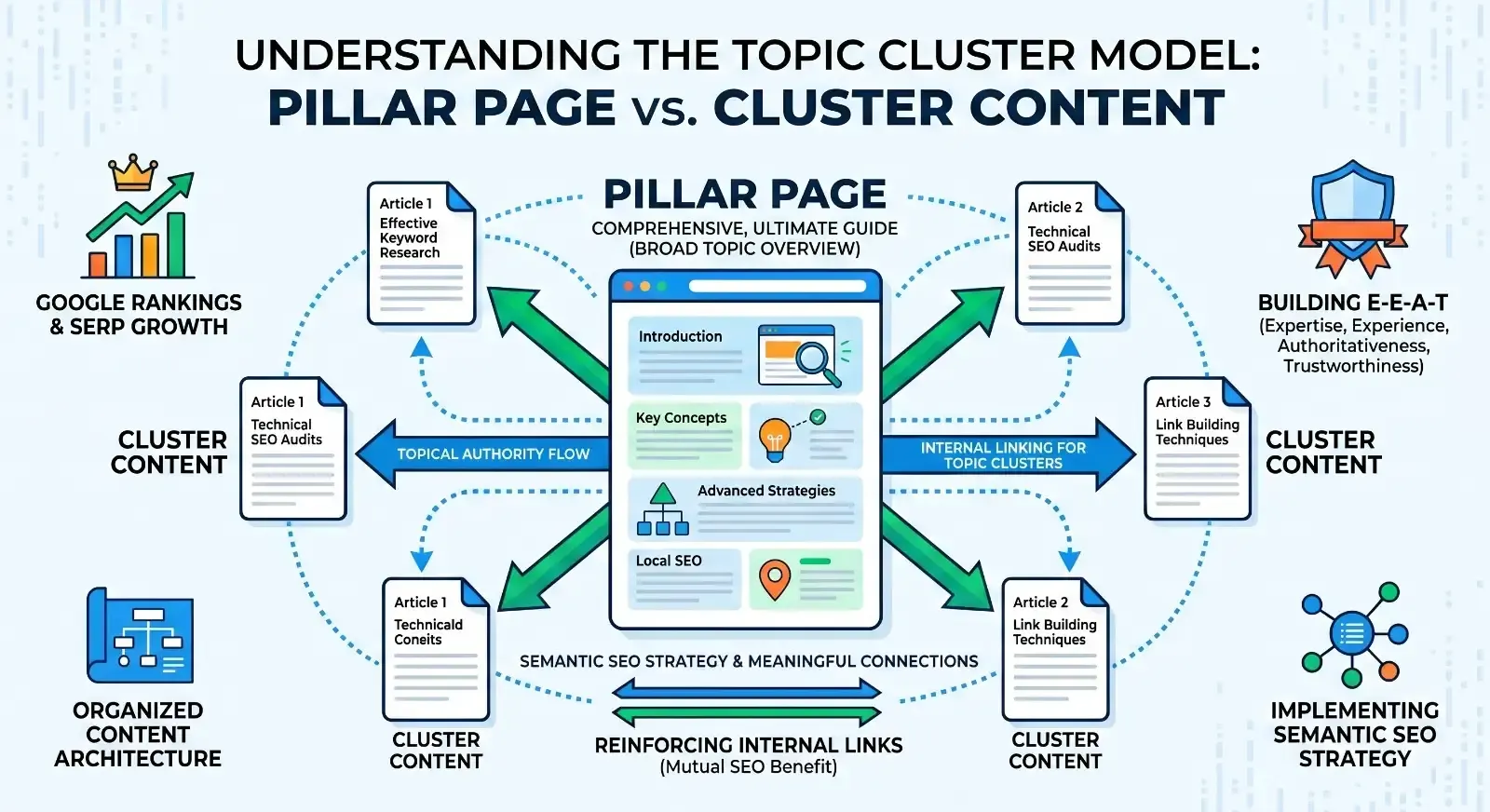
The hub and spoke content model organizes content around a central pillar page.
What Is a Pillar Page?
A pillar page is a comprehensive resource covering a broad topic.
How to Build Pillar Pages
A pillar page:
- Targets broad keywords
- Links to supporting articles
- Acts as the central authority page
Example:
Pillar page:
Complete SEO Guide
Supporting cluster pages:
- Technical SEO
- On-page SEO
- Link building
- Keyword research
Pillar Page vs Blog Post
| Pillar Page | Blog Post |
|---|---|
| Broad topic coverage | Narrow topic focus |
| Long-form resource | Specific question/article |
| Links to clusters | Supports pillar topic |
| Evergreen content | Often timely content |
What Is Cluster Content?
Supporting Cluster Content Explained
Cluster content focuses on subtopics related to the main pillar.
Example:
Pillar:
Email Marketing Guide
Clusters:
- Best email subject lines
- Email automation workflows
- Email segmentation strategies
Each cluster article targets specific long-tail keywords while supporting the main topic. For a complete guide on how to identify those long-tail keywords and cluster them effectively, follow this guide on how to do keyword research for SEO.
How Internal Links Connect the Cluster
Internal Linking for Topic Clusters
Internal links are the backbone of the cluster strategy.
Best practices:
- Link clusters to the pillar page
- Link pillar page back to clusters
- Cross-link relevant cluster posts
This strengthens:
- Link equity distribution
- Topical relationships
- Crawlability
A strong content silo SEO strategy helps Google understand your site structure clearly. For a full framework covering anchor text, link equity, and pillar-to-cluster linking, follow this internal linking strategy for SEO.
How to Build a Topic Cluster from Scratch
Step 1 — Choose Your Core Topic
Start with a broad topic that:
- Has business relevance
- Supports multiple subtopics
- Has long-term search demand
Good examples:
- SEO
- Email marketing
- Fitness
- WordPress
Avoid topics that are too narrow.
Step 2 — Identify Subtopics and Supporting Keywords
Semantic SEO Strategy
Use keyword research tools to identify:
- Supporting keywords
- Related searches
- Question-based topics
- Search intent variations
Good tools include:
- Ahrefs
- Semrush
- Google Search Console
- People Also Ask
Content Architecture Planning
Organize keywords into:
- Pillar topic
- Supporting clusters
- Subcategories
This creates scalable SEO architecture.
Step 3 — Create the Pillar Page
Your pillar page should:
- Cover the broad topic comprehensively
- Link to cluster articles
- Include navigational sections
- Provide high-level explanations
E-E-A-T Content Depth
Strong pillar pages demonstrate:
- Experience
- Expertise
- Trustworthiness
- Comprehensive coverage
Long-form content often performs best for pillar pages. Before publishing your pillar page, run through the full on-page SEO checklist for every article to ensure titles, headers, metadata, and internal links are fully optimized.

Step 4 — Build and Interlink Cluster Posts
Create supporting articles around:
- Long-tail keywords
- Subtopics
- Specific search intents
Hub and Spoke Content Model
The pillar acts as the hub, while clusters act as spokes.
Each article should:
- Link naturally to the pillar page
- Link to related cluster content
- Expand topical depth
This improves semantic relevance dramatically.
What Anchor Text to Use Between Pillar and Clusters?
Use:
- Natural anchors
- Partial-match keywords
- Descriptive phrases
Avoid:
- Overusing exact match anchors
- Generic “click here” text
Good anchor text strengthens contextual relevance.
Topic Cluster Examples That Rank
Example 1 — SEO Website
Pillar:
Technical SEO Guide
Clusters:
- XML sitemap optimization
- Core Web Vitals
- Crawl budget
- Canonical tags
For a full technical SEO cluster reference, see this technical SEO audit step by step in 2026. To build out the Core Web Vitals cluster specifically, follow this guide on how to improve Core Web Vitals WordPress. Schema markup is another key cluster topic covered in this guide on how to add schema markup to WordPress.
Example 2 — Fitness Website
Pillar:
Weight Loss Guide
Clusters:
- Meal planning
- Cardio workouts
- Fat-burning exercises
- Sleep and metabolism
Example 3 — Ecommerce SEO
Pillar:
WooCommerce SEO Guide
Clusters:
- Product page SEO
- Category page optimization
- Schema markup
- Site speed optimization
These clusters help websites dominate entire topic areas in SERPs. For platform-specific cluster building, see the WooCommerce SEO optimization complete guide, the Shopify SEO optimization guide 2026, and the WordPress SEO setup for beginners guide.

Common Topic Cluster Mistakes
Avoid these common problems:
- Weak internal linking
- Overlapping content
- Keyword cannibalization
- Thin cluster pages
- Poor content hierarchy
- Random publishing without structure
A topic cluster only works when content architecture is intentional and interconnected.
FAQs
How many cluster pages do I need per pillar?
Can a pillar page rank for multiple keywords?
What is the difference between a content hub and a pillar page?
Conclusion
A powerful topic cluster strategy for SEO helps websites build topical authority, improve internal linking, and dominate search results more effectively than traditional keyword-focused content strategies.
By creating pillar pages, supporting cluster content, and strong semantic SEO structures, you can improve rankings, increase crawl efficiency, and strengthen E-E-A-T signals across your entire website.
Topic clusters are no longer optional in modern SEO — they are one of the most effective ways to scale organic traffic and authority in 2026.